

The Structural Shift to Financialized Sports Analytics
The traditional boundaries separating sports betting, financial derivatives, and data intelligence officially collapsed on June 8, 2026. Sportradar Group AG finalized a landmark, multi-year global partnership with Kalshi, the premier regulated prediction market platform in the United States. This alliance shifts the paradigm of sports monetization away from typical consumer-facing bookmaker models toward high-frequency financial engineering. Under the terms of the agreement, Sportradar becomes the primary data and technology solutions provider for Kalshi’s rapidly expanding sports event contract marketplace.
For industry observers who view sports betting purely through a consumer lens, this development might look like a simple data distribution deal. It is not. Traditional risk mitigation methods, like a standard rolling accumulator strategy, are built for consumer retail platforms to maximize public retention. On an institutional exchange, risk and liquidity are managed strictly at the API layer. Kalshi operates as a Designated Contract Market regulated by the Commodity Futures Trading Commission. Traders on the platform do not buy traditional sports betting slips; they buy and sell binary financial contracts structured around real-world events. By integrating Sportradar’s premium data infrastructure, Kalshi is transforming volatile sports outcomes into structured asset classes for institutional market makers and retail traders alike.
The initial rollout covers a robust portfolio of major American sports leagues, including Major League Baseball, the National Hockey League, Major League Soccer, and the Ultimate Fighting Championship. As reported by the Sports Business Journal, this landmark multiyear global partnership signals the first massive bridge between traditional B2B sports data provisioning and federally regulated commodity exchanges, causing Sportradar’s stock to jump nearly 9% immediately following the announcement.
Unpacking the Tech Stack: APIs and Settlement Latency
The underlying value of this alliance lies entirely in data integrity and algorithmic latency reduction. In a traditional sportsbook environment, a multi-second delay in live data transmission represents a minor inconvenience or an opportunity for courtsiding. In a high-volume prediction market filled with automated trading algorithms, a sub-second data delay represents catastrophic financial exposure.
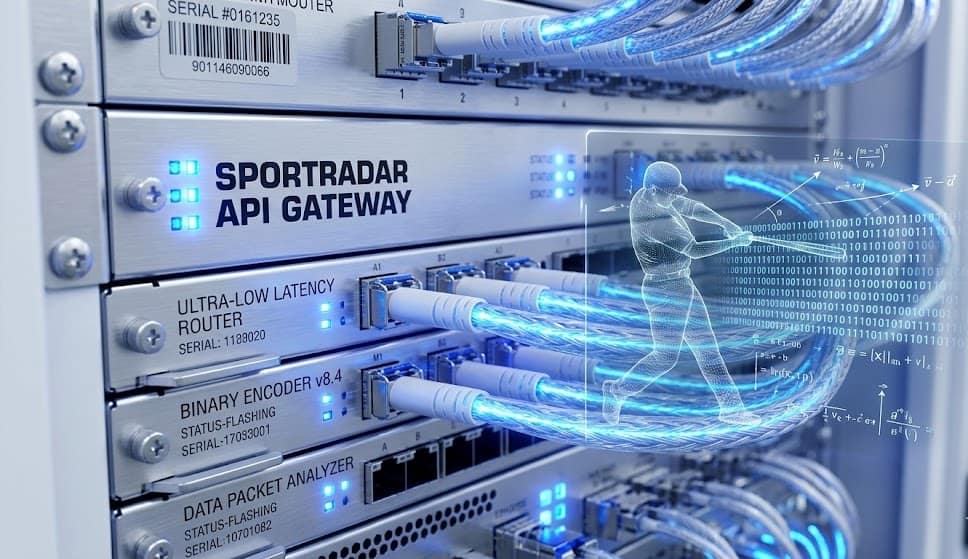
To power these binary sports contracts, Kalshi is integrating several core components of Sportradar’s advanced prediction services suite. The technology layer must process raw in-game events, transform them into standardized data vectors, and broadcast them to exchange participants simultaneously. This real-time synchronization allows market makers to quote tight bid-ask spreads without fear of getting picked off by stale pricing.
| Integration Layer | Core Technical Component | Primary Financial Objective |
|---|---|---|
| Official League Feeds | Low-latency, high-frequency match state data APIs | Minimizes tracking latency to enable rapid contract settlement |
| Live Odds Engines | Algorithmic pre-game and in-play implied probabilities | Establishes the baseline market-making matrix for liquid pairs |
| Integrity Architecture | UFDS AI behavior modeling & fraud detection tools | Identifies artificial volume or anomalous trading clusters |
The immediate commercial byproduct of this integration is faster trade settlements. In a standard betting model, payouts are processed minutes after the final whistle. In an exchange ecosystem, contracts tied to specific micro-moments—such as whether an MLB team scores in the third inning—require instantaneous verification to unlock trading capital for subsequent markets.
The Integrity Architecture: UFDS AI and Safeguards
Operating a sports exchange under the watch of federal financial regulators presents severe compliance hurdles. Prediction markets have recently faced heavy political and legal scrutiny, culminating in May 2026 when the United States Senate banned senators and their staff from wagering on these platforms due to insider trading vulnerabilities. Furthermore, state-level legal friction, including recent misdemeanor filings by the Arizona Attorney General alleging unauthorized gambling operations, emphasizes the urgent need for institutional-grade guardrails.
To protect the ecosystem from manipulation, Sportradar is deploying its Universal Fraud Detection System AI alongside the Sportradar Integrity Exchange. This security suite continuously monitors global betting data to flag irregular patterns, suspicious volume fluctuations, and potential match-fixing risks. By analyzing real-time biometric and tracking anomalies alongside exchange order books, the AI can detect if an entity possesses asymmetric information before the public market adjusts.
For Kalshi, this level of compliance infrastructure is mandatory. Because the platform functions as a federally approved exchange of regulated financial contracts rather than a state-licensed sportsbook, it must prove to the CFTC that its sports contracts serve a valid economic purpose and are immune to manipulation. The incorporation of certified data streams creates an immutable audit trail, providing a layer of security that shields the exchange from both retail fraud and systemic market distortions.
Why the NBA’s Absence Signals Market Hesitation
While MLB, the NHL, MLS, and the UFC have enthusiastically embraced this new distribution funnel, the National Basketball Association is noticeably missing from the initial Sportradar and Kalshi deployment. According to league officials, the NBA is intentionally maintaining a conservative posture, monitoring how prediction markets handle the complexities of high-scoring, player-prop-heavy data environments before fully licensing their official data rights to financial exchanges.

This hesitation highlights the core technical challenge of financializing modern sports: the sheer volume of macro and micro-variables. A basketball game features hundreds of possessions, rapid player substitutions, and micro-injuries that drastically alter live lines within fractions of a second. If an exchange lacks an incredibly sophisticated data normalization layer, arbitrary contract settlement disputes could paralyze trading volume.
The primary business objective for Sportradar’s newly minted Prediction Services segment throughout the remainder of 2026 will be proving that its automated trading frameworks can elegantly scale across these highly fluid data environments.
The Institutionalization of Sports Event Contracts
The collaboration between Carsten Koerl and Tarek Mansour marks a definitive turning point for the business of sports analytics. For years, sportsbooks treated data as a tool to set a line and extract a margin from retail players. This alliance proves that the future of sports data lies in its financialization—treating athletic performances as dynamic, investable indices.
As prediction markets mature over the next fiscal cycle, the reliance on fragmented, scraped, or unofficial data streams will become entirely unviable for any platform seeking institutional liquidity. By embedding Sportradar’s high-frequency data infrastructure directly into Kalshi’s exchange architecture, the sports analytics sector has officially established the technical and compliance blueprint required to transform public sports opinions into highly regulated, liquid financial assets.
To understand the broader economic forces and regulatory battles driving this shift toward event-based asset classes, watch the WSJ Breakdown of Prediction Market Economics, which details how platforms like Kalshi navigate the fine line between traditional commodity trading and sports wagering.